iii-hq/
View on GitHubEffortlessly compose, extend, and observe every service in real-time for the first time ever.
Effortlessly compose, extend, and observe every service in real-time for the first time ever.
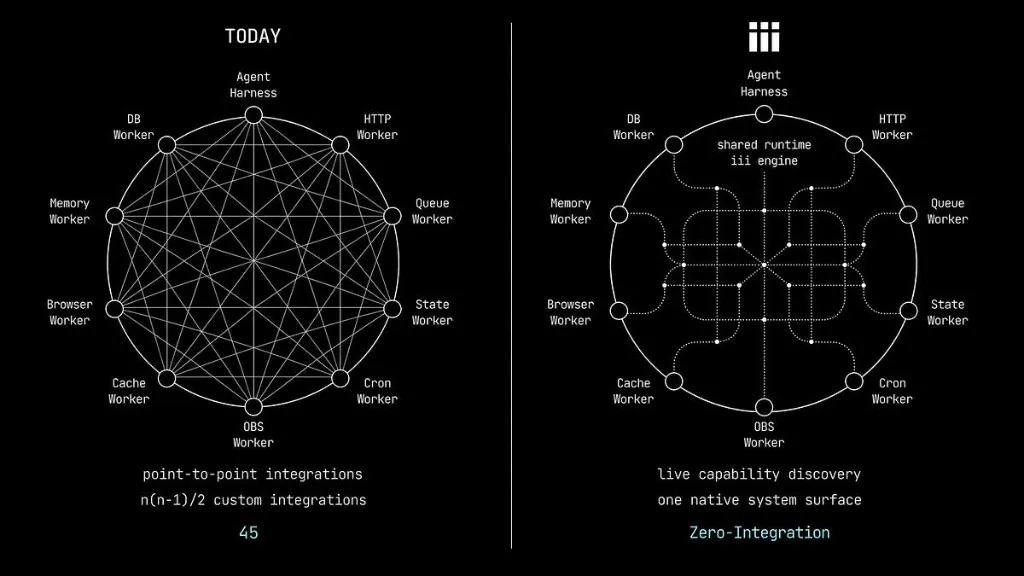
iii is the easiest way to compose, extend, and observe every service in your stack in real time.
Every backend starts as a project before the first line of business logic. Queues, cron, HTTP, state, observability, agents, and sandboxes each usually bring their own integration story. iii collapses that into one live system surface.
iii compose --namespace dev --up
iii trigger -n dev compose::add worker=queue
iii trigger -n dev compose::add worker=agent
iii trigger -n dev compose::add worker=<anything>
Each worker joins the live catalog. Every other worker is notified and can call it immediately. Browse available workers at workers.iii.dev.
That is the agent story too: when a task needs a capability the system does not have, an agent can add a worker, discover its functions, call them, and trace what happened. Same interface a developer uses.
Worker _ Function _ Trigger is the entire mental model.
Workers are processes that register with the iii engine and then register triggers and functions. A TypeScript API service is a worker. A Python data pipeline is a worker. A Rust microservice is a worker. Any functionality can be transformed into a worker with a few lines of code. Compose can also add workers at runtime, so agents and applications can extend the system while it is running.
Triggers are anything that causes a function to run. A trigger can be a direct call to a function, an HTTP endpoint, a cron schedule, a queue subscription, a state change, a stream event, or anything else. Triggers are declarative: the Worker defines "this function runs when this thing happens," and iii handles routing, serialization, and delivery.
Functions are units of work with a stable identifier (e.g., content::classify,
orders::validate). It receives input, does work, and optionally returns output. Functions exist in
workers.
By mapping everything a service can do to these three primitives iii creates a development process that is both effortlessly composable, and completely observable.
Before iii:
After iii:
worker-compose.yamliii compose --upPlatform teams publish workers. Application teams register functions and declare triggers. Agents use the same catalog and the same function calls.
Extending iii is adding a Compose worker. Composing iii is calling functions. Observing iii is opening the trace.
Install iii:
curl -fsSL https://install.iii.dev/iii/main/install.sh | sh
Then scaffold and start a project:
iii project init myapp    # scaffold a project
cd myapp
# declare project workers in worker-compose.yaml
iii compose --up          # start the engine and project workers
Full walkthrough at the Quickstart guide.
Declare project workers in worker-compose.yaml, or add them through a running Compose daemon:
iii trigger -n dev compose::add worker=queue
Browse packages at workers.iii.dev and see the Compose documentation.
| Language | Package | Install |
| -------- | -------------------------------------------------- | ------------------------------------------- |
| Node.js | iii-sdk | pnpm add iii-sdk or npm install iii-sdk |
| Python | iii-sdk | pip install iii-sdk |
| Rust | iii-sdk | Add to Cargo.toml |
| Go | iii-sdk | go get github.com/iii-hq/iii/sdk/packages/go/iii |
Install iii's agent-readable reference material for the engine primitives:
npx skills add iii-hq/iii/skills
These cover every iii primitive: HTTP endpoints, queues, cron, state, streams, custom triggers, and more. See skills/ for the full list.
Each worker in iii-hq/workers also ships its own skill. Install them alongside the worker itself:
npx skills add iii-hq/workers --list        # list available worker skills
npx skills add iii-hq/workers --skill database # one worker
npx skills add iii-hq/workers --all         # every worker skill
The engine-owned workers (configuration, iii-worker-manager, iii-http-functions,
iii-stream, and iii-sandbox) and the automatically supplied engine functions, telemetry, and
observability workers live in this repo. HTTP, cron, queue, state, pubsub, and bridge are standalone
Compose workers. Install an engine skill with
npx skills add iii-hq/iii --full-depth --skill <name>; standalone workers ship their own skills in
iii-hq/workers.
The iii-console is a developer and operations console for inspecting workers, functions, triggers, queues, traces, logs, and real-time state. See the Console docs for setup and usage.
| Directory | What it is | README |
| ---------- | ------------------------------------------------------- | -------------------------------------- |
| engine/ | iii Engine (Rust) - core runtime, modules, and protocol | engine/README.md |
| sdk/ | SDKs for Node.js, Python, Rust, and Go | sdk/README.md |
| console/ | Developer console (React + Rust) | console/README.md |
| skills/ | Agent-readable reference material | skills/README.md |
| website/ | iii website | website/ |
| docs/ | Documentation site (Mintlify/MDX) | docs/README.md |
See STRUCTURE.md for the full monorepo layout, dependency chain, and CI/CD details.
See the Quickstart guide for step-by-step tutorials.
The iii is licensed as such:
| Directory | License |
| ---------- | ------------------------------------- |
| engine/ | Elastic License 2.0 |
| sdk/ | Apache License 2.0 |
| console/ | Apache License 2.0 |
| docs/ | Apache License 2.0 |
| website/ | Apache License 2.0 |
The engine runtime is licensed under the Elastic License 2.0 (ELv2). All SDKs, CLI, console, documentation, and the website are licensed under the Apache License 2.0.
See CONTRIBUTING.md for additional details.
No comments yet. Set the tone — say what you would want to know.